Interlocking Jigsaw Puzzles and How the Pieces Are Cut
Every jigsaw piece holds on to its neighbors with the same small trick: a rounded tab on one side that slots into a matching blank on the next piece. That is all interlocking means, and it is why you can slide a finished puzzle across the table without it coming apart. Here is where the shapes come from, in a factory and on Jigsaway.
Tabs, blanks and edges
Puzzlers have a few names for the parts of a piece. The bump that sticks out is a tab, also called a knob. The hollow it fits into is a blank, or a hole. Edge pieces have one flat side and corners have two, which is why most people find them first.
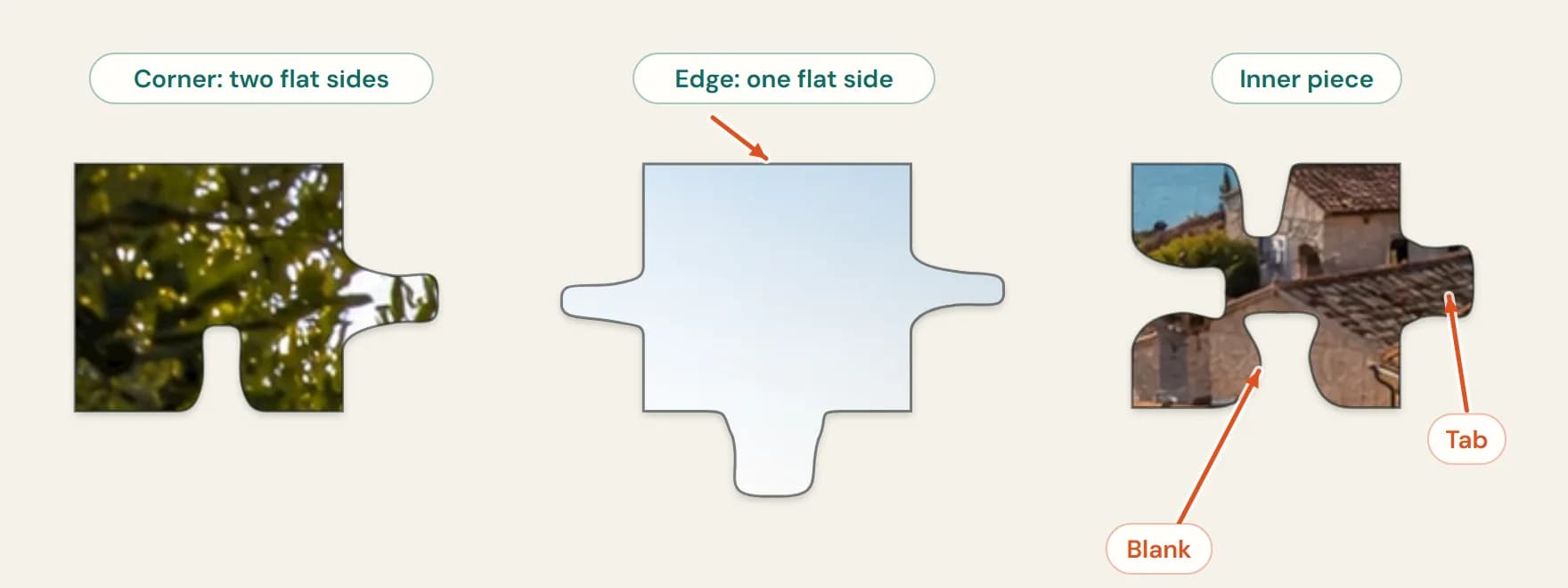
Inside the border, each piece carries some mix of tabs and blanks on its four sides. A piece with two tabs opposite each other looks very different from one with two tabs side by side, and that difference is what you fall back on when the color runs out. Sorting by shape is one of the habits in our jigsaw puzzle tips.
Grid cut and random cut
| Cut | What the pieces look like | How it plays |
|---|---|---|
| Grid cut (also called ribbon cut) | Rows and columns of pieces about the same size, each with tabs and blanks | Rows build neatly. In a big sky many pieces look alike, so you lean on the picture. |
| Random cut | Irregular shapes with no straight rows | Each shape is easier to tell apart, but harder to guess where it goes. |
Wooden puzzles often add whimsies, pieces cut as a recognizable shape, like a bird, a key or a leaf. They are fun to find and easy to place, so they tend to go in early.
How a cardboard puzzle is cut
Most boxed puzzles are die-cut. The picture is printed, glued to thick board and pressed against a die: thin steel blades bent into the outline of every piece and set into a block. One press of the machine cuts the whole puzzle at once. Because the same die cuts every copy, two boxes of the same puzzle have exactly the same pieces.
Wooden puzzles are made differently. Many are cut by laser now, and some are still cut one piece at a time by hand with a fine saw, which is why they cost more.
Pieces did not always lock
The earliest puzzles, made in London in the 1760s, were maps glued to wood and cut along the borders between countries. The pieces simply sat next to each other, and a knock to the table scattered them. Later puzzles were cut with a fine fretsaw, a tool many people called a jigsaw, and that is where the name comes from. Interlocking pieces became common in the early 1900s as makers got better at cutting them. By the 1930s newsstands sold a new die-cut cardboard puzzle each week, cheap enough to pick up on the way home.
How the pieces on Jigsaway are cut
Every puzzle here is grid cut, with the rows and columns matched to the shape of the picture. A wide 104-piece puzzle, for example, is 8 rows of 13. Each side between two pieces gets a tab or a blank, chosen at random, so most pieces have one to three tabs and a few have four or none. The outside edges are flat.
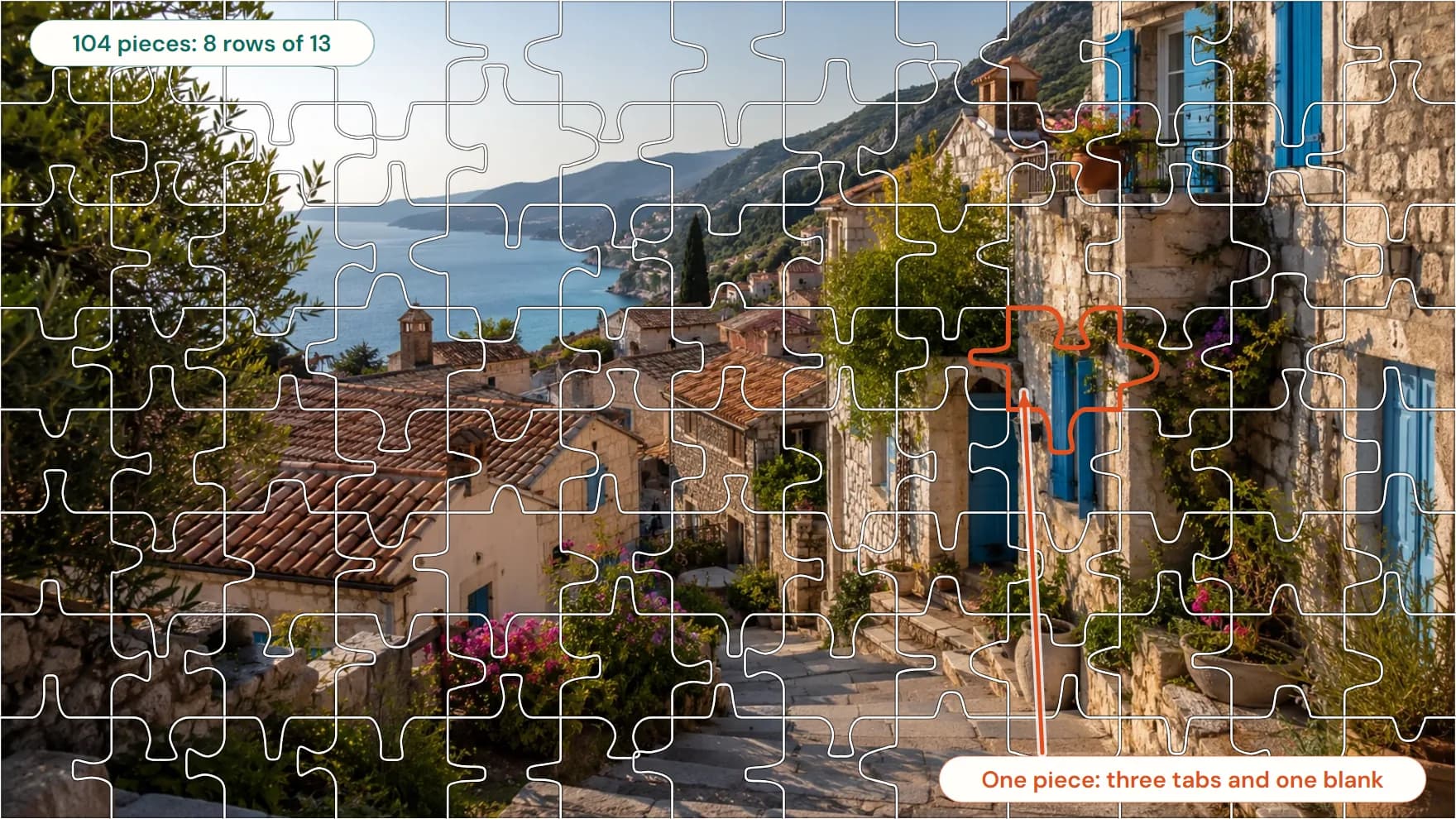
The cut is fixed for each puzzle and piece count. Everyone who plays a puzzle at 300 pieces gets the same 300 pieces, which is what keeps times on the leaderboards fair. When you bring a piece close to a neighbor it belongs to, it snaps into place, and pieces that are joined move together as one group. To find the border quickly, use Light up edges on the board. The how to play page covers the rest of the controls.